Research · Oct 2, 2026 · 6 min read
What a maintenance call costs on OpenAI’s gpt-realtime
We priced 104 real calls on MaintenanceTech at OpenAI’s published rates for its gpt-realtime model. The answer is 10 to 15 cents a minute — and a third to a half of it is the AI’s own voice. First in a series.
We priced 104 real calls that MaintenanceTech’s AI placed on recorded phone lines, at the rates OpenAI publishes for its realtime voice model. This is what the model bills for a maintenance call.
The number
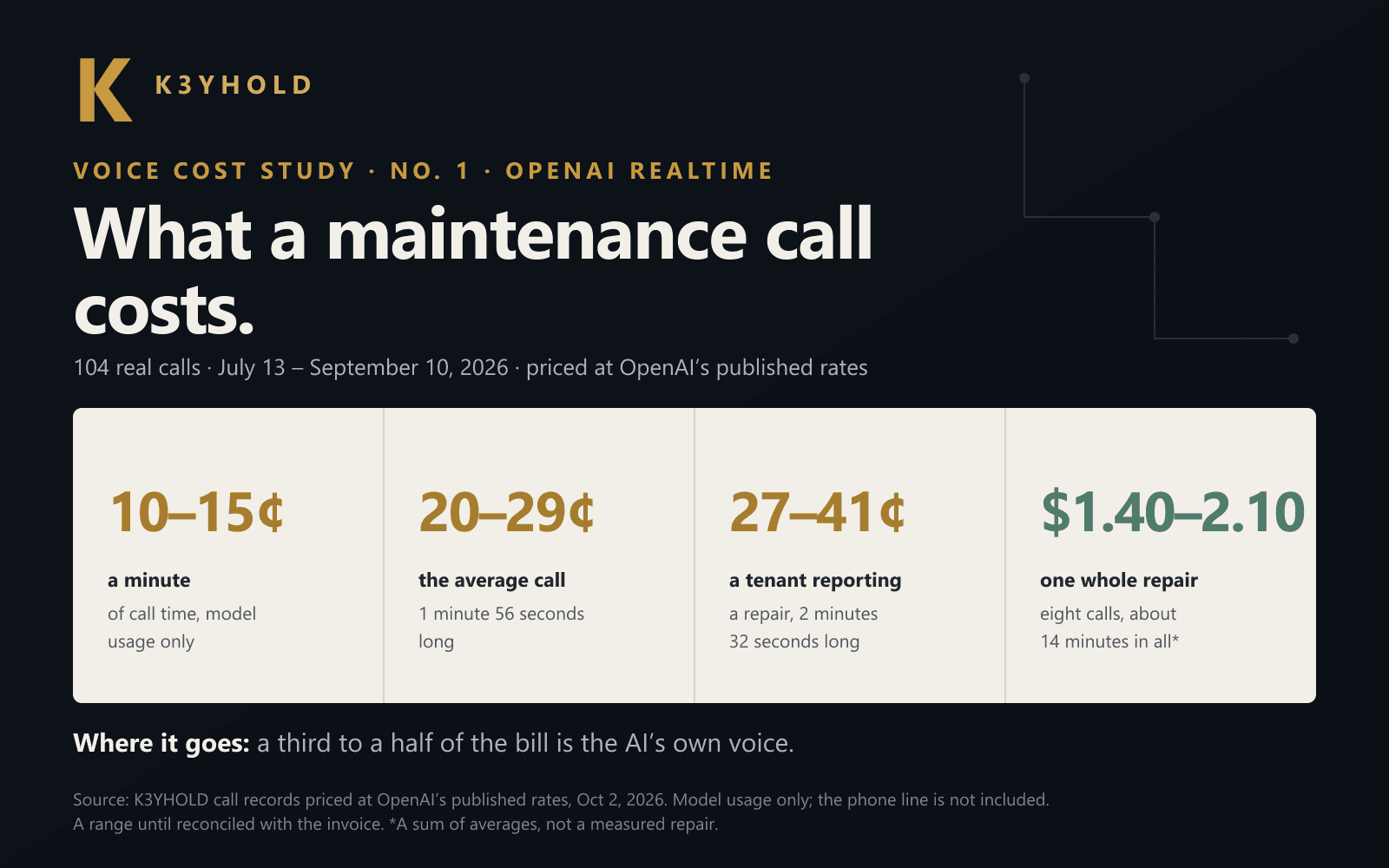
10 to 15 cents a minute. The average call lasted 1 minute 56 seconds and cost 20 to 29 cents. The phone line added about 1.4 cents a minute on top.
- 10–15¢
- a minute of call time, at OpenAI’s published rates.
- 20–29¢
- for the average call, 1 minute 56 seconds long.
- ⅓ – ½
- of the model bill is the AI’s own voice.
- $1.40–2.10
- for one whole repair’s calls — a sum of averages, not a measured repair.
By kind of call
The tenant’s report is the longest call because the AI has to confirm who it is talking to, ask what is wrong, ask about access, and read the whole thing back. Lengths are averages across 39, 27, 7 and 6 calls respectively.
One whole repair
Add the calls a single repair usually takes — the report, three vendor quotes, the booking, the tenant’s confirmation, the owner’s approval and a follow-up — and you get about 14 minutes of calls, $1.40 to $2.10 of model usage, and about 20 cents of phone time. This is a sum of averages, not a measured repair; it is here so the per-minute price has a shape.
Where the money goes
A third to a half of the bill is the AI’s own voice. Speech the model produces is its most expensive token — twice the price of speech it hears, four times the price of text. Every sentence the AI says costs money, so a call written tight is a cheaper call. That is a lever a platform holds, not a model vendor.
A call you can hear
The tenant-intake call on this site, recorded August 14, 2026, cost 25 to 45 cents of model usage and under 5 cents of phone time over 3 minutes 19 seconds on the line. Watch it, start to finish, with the transcript.
Why a range
Our records count the discounted repeat tokens as one number and do not say how much of it was speech and how much text. The low end of each range assumes the discount landed on speech; the high end, on text. The invoice for the period settles it, and that is the figure we will print when it does.
OpenAI also lists a smaller realtime model at roughly a third of these rates. We have not measured it.
Questions this study answers
How much does an AI maintenance call cost?
On MaintenanceTech, OpenAI’s gpt-realtime billed 10 to 15 cents a minute of call time across 104 real calls. The average call, 1 minute 56 seconds long, cost 20 to 29 cents. The phone line adds about 1.4 cents a minute on top.
Is that what K3YHOLD charges?
No. It is what the model vendor bills for the model’s work on a call, at its published rates. K3YHOLD’s own pricing is discussed when access to the Arizona beta is granted.
Why is every figure a range?
Our records count discounted repeat tokens as one number without saying how much was speech and how much text. The low end assumes the discount fell on speech, the high end on text. The invoice for the period settles it, and the page will print that figure.
Does the cost include the phone line?
No. The figures are model usage only. The carrier’s published outbound rate adds about 1.4 cents a minute, reported separately so neither leg is counted twice.
Were these customer calls?
No. The people on the line were K3YHOLD staff playing tenant, vendor and owner on our supervised validation line, and every call was on a recorded line with the AI and recording disclosure spoken.
Will other voices be measured the same way?
Yes. The next studies run one fixed set of calls on other realtime voices, and the last one measures HueMann Mini served from K3YHOLD’s own servers powered by solar, with battery backup, with its cost counted all the way down to the hardware.
Sources
- OpenAI, “API pricing — Realtime and audio generation models,” openai.com/api/pricing, as published on October 2, 2026.
- K3YHOLD call records, July 13 – September 10, 2026: per-turn token usage and line time for 159 recorded calls.
K3YHOLD’s own study. OpenAI did not sponsor, review or take part in it. The prices are OpenAI’s published rates; the call records are K3YHOLD’s. The figures describe what the model bills and are not a K3YHOLD price.
Published by K3YHOLD, Oct 2, 2026.