Research · Jun 12, 2026 · 8 min read
Small landlords are already using AI to choose property managers
The 2026 PM Trends Report suggests the AI question has moved. It is no longer whether small owners will use the technology — it is whether the operating experience behind the promise deserves their trust.
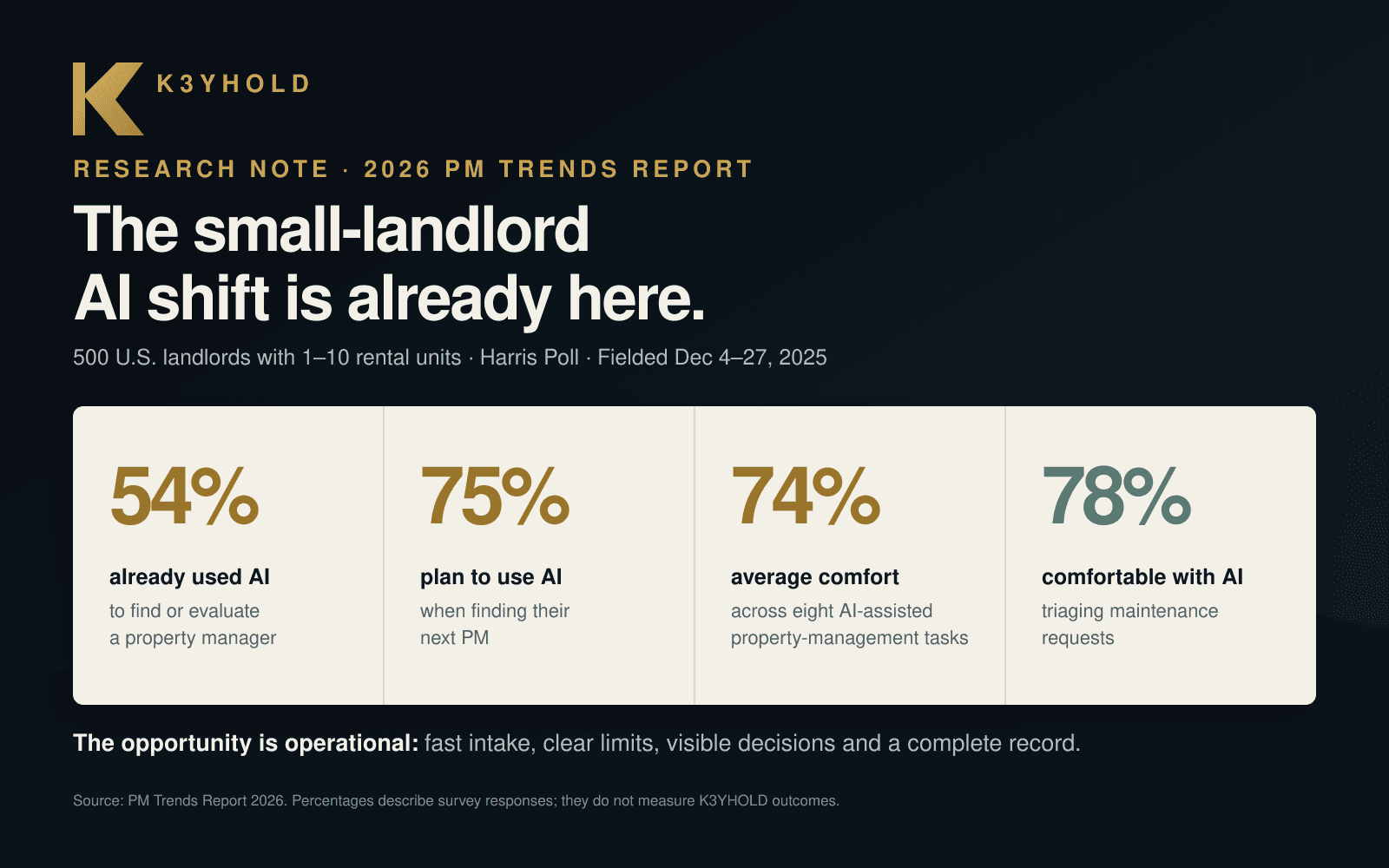
Property managers have spent years thinking about where owners discover them: referrals, search results, reviews, local reputation. The 2026 PM Trends Report adds a new front door. More than half of the small landlords surveyed said they had already used an AI tool to find or evaluate a property manager.
That number deserves attention. But the more consequential finding sits just behind it: 75% plan to use AI when they look for a property manager in the future. This is not a distant adoption curve. It is an active change in how owners gather information and decide who appears credible.
What the survey actually measured
The report is based on a national survey of 500 U.S. adults who own one to ten rental units. Harris Poll fielded it from December 4 through December 27, 2025. Roughly half of the respondents used a property manager and half did not. That population matters: these are small landlords, not institutional owners, and not a survey of property-management companies.
- 54%
- had already used AI to find or evaluate a property manager.
- 75%
- planned to use AI when finding their next property manager.
The report also tested comfort with AI-assisted property-management work. Across eight tasks, average comfort was 74%. Maintenance stood out: 78% were comfortable with AI triaging maintenance requests. Even a more sensitive interaction — AI calling an owner about a maintenance issue — received 63% comfort.
Comfort is not the same as unconditional permission. A survey answer does not tell us whether an owner would accept a system with hidden automation, unclear accountability or no way to reach a person. It does tell us that the blanket objection — “owners will never accept AI in property management” — no longer fits the evidence.
The discovery layer and the operating layer are converging
If an owner asks an AI assistant to recommend a property manager, the answer will be assembled from whatever the model can understand about that company: its service area, its public explanations, its policies, its reviews and the consistency of its claims. Vague websites and locked-away operational knowledge become harder to defend.
Then comes the second test. The company that sounds modern during discovery has to work that way after the agreement is signed. A maintenance request still needs to be understood. Someone has to call the resident back, reach a qualified vendor, compare availability, respect the owner’s approval limit, schedule the visit and confirm the work was completed.
The credibility gap opens when AI appears in the sales story but disappears from the work — or when it enters the work without clear boundaries. This is why “we use AI” is not a useful operating model by itself. Owners need to know where automation acts, when it stops, what record it creates and who is responsible when the situation becomes unusual.
What each person in the maintenance loop should get
Tenants. A fast acknowledgment, questions that gather the missing facts, honest AI disclosure, clear updates and a reliable path to a person when the issue is urgent or unusual.
Property managers. Less time rebuilding the same story across phone calls, texts and vendor conversations, with visibility into the exceptions that genuinely require judgment.
Owners. Standing rules for routine work, approval gates for consequential spending, concise context when a decision is needed and a record of what happened.
Owner-operators. Operational leverage without pretending they have a round-the-clock team: structured intake, outbound coordination and decisions collected in one place.
The common thread is not “more AI.” It is fewer dropped handoffs. A useful system should make the routine work move while making human responsibility easier to see.
The maintenance use case is a practical place to start
Maintenance is repetitive enough to benefit from structured automation and consequential enough to require boundaries. The questions repeat. The phone work repeats. The need to capture availability, quotes and access details repeats. Yet a burst pipe, a vulnerable resident, an uncertain diagnosis or a quote above the owner’s limit should not be waved through by default.
That combination explains why the survey’s 78% comfort level around AI triage is important. Triage is a real job with a definable handoff. It does not require pretending that every maintenance decision should be autonomous.
Read the signal without outrunning it
The PM Trends data gives the industry a useful permission signal. Small landlords are not only encountering AI. Many are using it to research providers, and large majorities say they are comfortable with assistance in concrete property-management tasks.
It does not prove that any specific AI workflow is safe, accurate or valuable. It does not measure tenant experience. It does not show that adopting a tool causes better retention or lower costs. Those questions belong in a controlled pilot with defined measures: time to first response, time to first action, time to completion, number of resident follow-ups, human escalations, approval delays and cost per completed job.
The opportunity is not to automate for its own sake. It is to make the operating chain visible, responsive and accountable enough that tenants, property managers and owners can all trust what happens next.
Sources
- PM Trends, 2026 PM Trends Report — a Harris Poll survey of 500 U.S. landlords with 1–10 rental units, fielded December 4–27, 2025.
- Peter Lohmann, “PM Trends Report 2026: My Top 10 Favorite Findings from 500 Small Landlords,” May 29, 2026.
Independent commentary. K3YHOLD did not sponsor, conduct or participate in the PM Trends survey, and has no commercial relationship with its publishers.
Published by K3YHOLD, Jun 12, 2026.