Research · Sep 9, 2026 · 8 min read
The repair is not the whole problem. The silence around it is.
Buildium's 2026 Renters' Report puts numbers behind a familiar frustration: residents are judging the response, the updates and the follow-through — not only the finished repair.
A resident reports an air conditioner that stopped cooling. The request exists in a system. The property manager knows about it. A vendor will probably be called. Yet for the person sitting in a hot unit, none of that feels like progress until someone responds and explains what happens next.
That gap between recorded work and experienced progress is where trust thins out. Buildium’s 2026 Renters’ Report, based on a survey of 1,500 U.S. renters, shows how much of the resident experience now turns on maintenance communication.
The 24-hour clock is already running
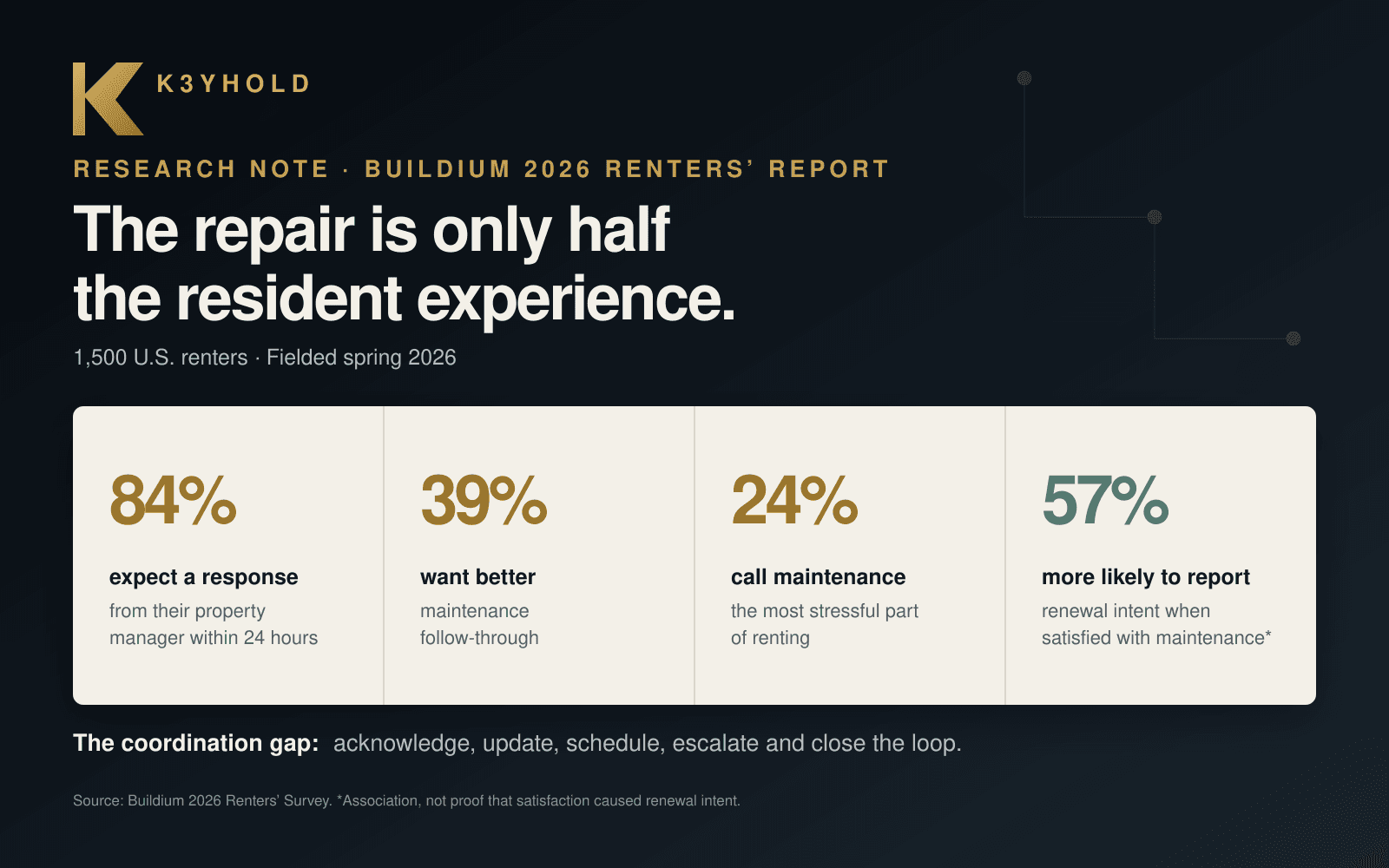
Eighty-four percent of renters expect a response from their property manager within 24 hours. Buildium also reports that 61% expect a response the same day or faster. Those expectations do not necessarily mean a repair must be completed in a day. They do mean silence is read as failure long before the work order reaches the vendor.
- 84%
- expect a property manager response within 24 hours.
- 39%
- say better maintenance follow-through would improve their experience.
Follow-through is the larger story. When Buildium asked what property managers could improve, 39% chose better follow-through on maintenance requests — more than faster message response, easier payments, clearer fees or easier access to documents.
The report describes the source of friction in plain terms: delays without explanation, missing updates and repeated follow-ups. The resident is not simply waiting for a technician. The resident is doing the coordination work that the operation failed to make visible.
Maintenance is also an information problem
Repairs are physical. The coordination around them is informational. A useful maintenance operation has to keep several versions of reality aligned: the tenant knows what was received, whether the issue may be urgent and when to expect another update. The property manager knows what has been tried, who has been reached and what is blocking the next step. The vendor knows the actual symptom, the unit and access details, the requested service window and who can approve additional work. The owner knows when a decision is needed, why it is needed and what happens if the decision waits.
Most breakdowns are not dramatic. They are little breaks in that shared picture. The tenant gives a detail in a call that never reaches the work order. The vendor leaves a voicemail that no one connects to the right request. An owner approval sits in a text thread. A completion note arrives, but no one confirms with the resident that the problem is actually solved.
A work order can be open in software and still feel abandoned to the resident. That is the technology gap. Many systems are good at storing the official record. Far fewer are built to carry the phone work, follow-ups, decisions and confirmations that move the record from open to closed.
The retention number needs careful reading
Buildium reports that renters satisfied with maintenance were 57% more likely to say they planned to renew their lease. The same group was 60% more likely to recommend their property manager and 48% more likely to perceive good value.
Those are meaningful associations. They are not proof that improving maintenance satisfaction by itself causes a particular increase in renewals. Satisfaction, property condition, rent, location and management quality can move together. The measure is reported intent, not observed lease renewal.
Still, the direction is hard to ignore. Maintenance is one of the few parts of the renter experience that operators can influence every week, and 24% of respondents called it the most stressful part of renting. Better coordination does not guarantee retention. Poor coordination gives residents a recurring reason to reconsider the relationship.
What better follow-through can look like
For tenants. A clear acknowledgment, a few useful questions, realistic timing, status updates when something changes and confirmation before the request is closed.
For property managers. A structured issue record, outbound calls handled consistently, exceptions surfaced early and a timeline that makes ownership obvious.
For owners. Routine work moving within agreed limits, and approval requests arriving with the quote, the context and the consequence of delay.
For owner-operators. A way to cover calls and coordination without losing control of spending, vendor choice or the relationship with the resident.
None of this requires removing people from the process. It requires using people where judgment matters instead of making them manually carry every status update between systems and phone conversations.
A pilot should test the whole loop
A fast first reply is useful, but it can become a vanity metric if nothing happens afterward. The stronger test follows the request from first report through final confirmation.
A practical maintenance-coordination pilot should measure time to first response, time to first action, time to vendor contact, time to schedule, time waiting for approval, time to completion, resident follow-up count, escalations and confirmation after the visit. It should also track cost and the reasons work stalls. Then ask the residents and operators a simpler question: did they know what was happening without having to chase someone?
The Buildium report makes the opportunity concrete. Residents are not demanding magic. They are asking for a response, a visible next step and evidence that someone is still carrying the issue. That is a solvable operating problem.
Sources
- Buildium, 2026 Renters’ Report: “Property Managers Have More Control Over Retention Than They Think” — a survey of 1,500 U.S. renters fielded in spring 2026, published August 26, 2026.
- Buildium, “How property managers are turning maintenance into a competitive advantage in 2026.”
Independent commentary. K3YHOLD did not sponsor, conduct or participate in Buildium’s survey, and the platform has no live integration with Buildium’s software.
Published by K3YHOLD, Sep 9, 2026.